
Minimal disruption
We schedule loud work, deliveries and lifts around business hours and keep entrances, parking and walkways safe and clear.
Commercial Roofing
For property managers, owners and associations who need a roof that stays dry, a contractor who communicates, and paperwork that holds up to scrutiny.
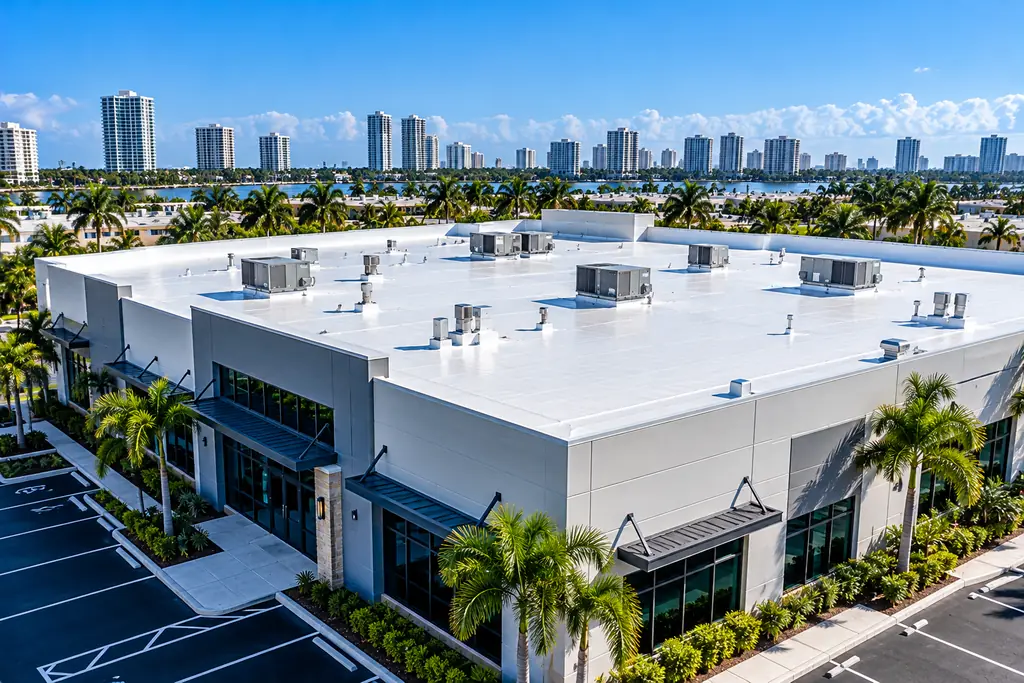
Built Around Your Property
We schedule loud work, deliveries and lifts around business hours and keep entrances, parking and walkways safe and clear.
Photo reports, written findings and itemized proposals give boards and owners what they need to make decisions.
We help you separate urgent repairs from work that can be planned, so roof spending can be scheduled instead of reactive.
A single contact keeps your property manager informed on schedule, weather delays and any conditions found during the work.
Roof Systems
Every building is different. This is a general, qualitative overview — the right system depends on your deck, drainage, rooftop equipment and budget.
| Feature | TPO | Modified Bitumen | Roof Coatings | Standing-Seam Metal |
|---|---|---|---|---|
| What it is | Single-ply thermoplastic membrane with heat-welded seams | Multi-ply asphalt-based membrane, often with a granulated cap sheet | Fluid-applied silicone or acrylic layer over an existing sound roof | Interlocking metal panels with raised seams, for suitable low slopes |
| Surface & heat | Typically white and reflective, which reduces heat gain | Darker unless a reflective cap or coating is used | Reflective white finishes are common | Reflective finishes available |
| Good fit for | Large, open flat roofs on retail and office buildings | Roofs with foot traffic or many penetrations | Extending the life of a roof that is still dry underneath | Buildings where pitch allows and a long-term metal system is preferred |
| Watch points | Seam welding quality and detailing around equipment | Proper laps and flashing at edges and curbs | Not a fix for wet insulation or a failed deck | Fastener and coating choices near salt air |
| Upkeep | Periodic seam and flashing checks | Inspect for blistering and cracking | Periodic recoating over time | Check fasteners, sealants and trim |
General comparison only. Performance depends on the specific product, installation and building conditions. We recommend a system after inspecting your roof.
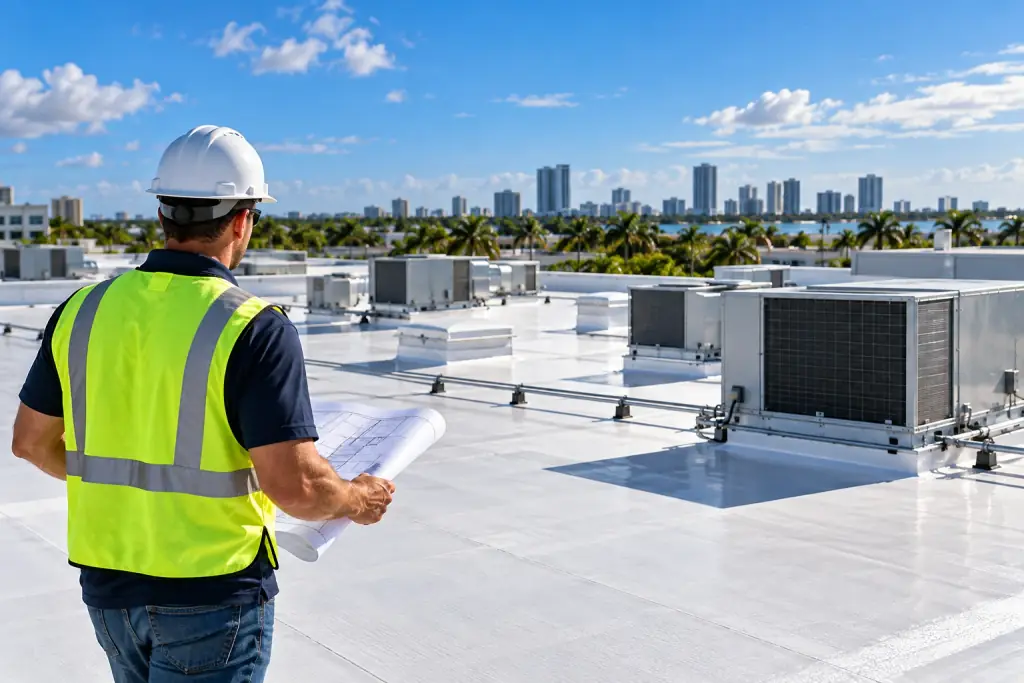
Preventive Maintenance
Most commercial roof leaks start small: a clogged drain, an open seam, a cracked sealant joint at a rooftop unit, or flashing that has pulled away after a storm. Left alone, water gets into insulation, and wet insulation is far more expensive to fix than the original problem.
Regular check-ups — commonly before and after hurricane season — catch these problems early. Ask us about scheduling recurring visits for your building. Any repairs we recommend come with a written scope, so you decide what gets done and when. Larger concerns can be evaluated with a full roof inspection.
Maintenance Checklist
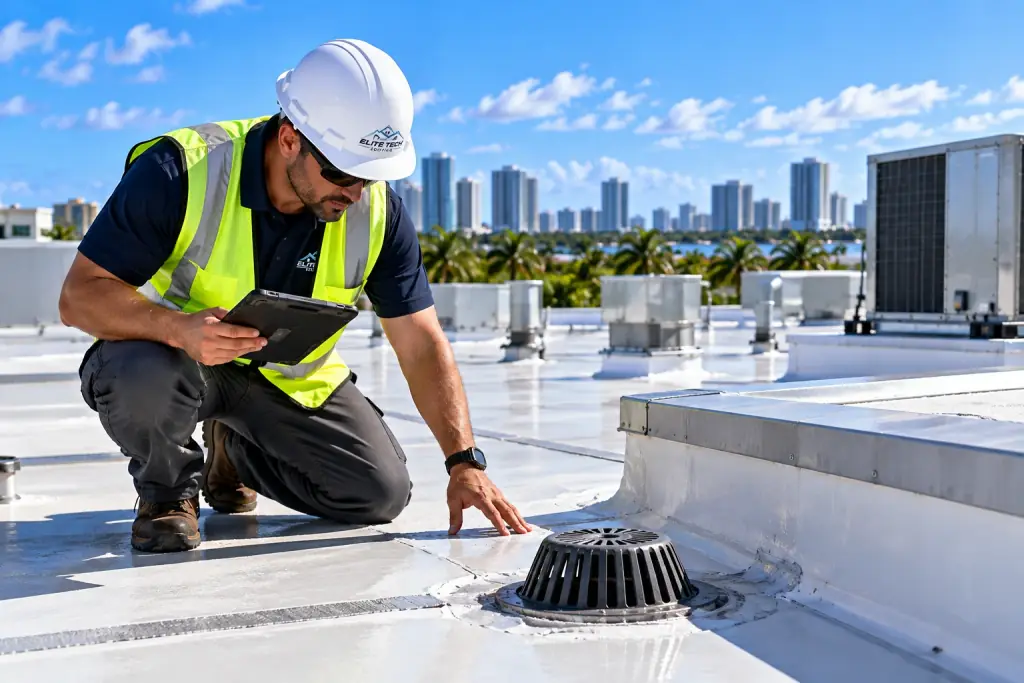
A typical maintenance visit covers the areas where low-slope roofs most often fail.
FAQ
We work on low-slope and flat roofs found on retail centers, offices, warehouses, condominium and HOA buildings, and similar properties. Tell us about your building and we will let you know whether it is a good fit for our team.
In most cases, yes. We plan staging, material deliveries, crane lifts and noisy work around your operating hours and tenant needs, and we coordinate access and safety zones with your property manager before work starts.
No. A silicone or acrylic coating can extend the useful life of a roof that is still structurally sound and mostly dry underneath. It is not a fix for saturated insulation, a failed deck or widespread membrane damage. A core sample and inspection help determine whether a coating is a reasonable option.
A common practice is to inspect low-slope roofs at least twice a year — often before and after hurricane season — and after any significant storm. Regular checks catch clogged drains, open seams and flashing issues while they are still small repairs.
Yes. We provide photos and a written assessment of what we find, along with itemized proposals, so property managers and boards can review conditions and plan budgets with clear information.
Ponding usually comes from clogged drains or scuppers, sagging deck areas, or insulation that has compressed over time. Standing water stresses membranes and seams, especially during South Florida’s heavy summer rains, so it is worth having evaluated.
Request a site visit and receive a written assessment with photos you can share with ownership or your board.
Enter your info below and our team will reply by text message.
We'll text you back at the number you provided shortly.